Why This Repair Matters
Foundation settlement occurs when the soil beneath your home can no longer adequately support the structure's weight. In Laval, expansive clay soils, poor drainage, and frost heave are common culprits. Settlement causes cracked walls, uneven floors, and sticking doors — and worsens over time if left untreated.
Key Benefits
- Halts ongoing settlement immediately
- Can restore foundation to original elevation
- Minimally invasive installation
- Engineered and load-tested
- Permanent solution with warranty
Why Foundations Settle in Laval
Laval's foundation settlement problem is rooted in its geology. The marine clay soils underlying most of the island shrink dramatically during dry periods and swell when saturated — a process called soil plasticity. This cyclical volume change creates uneven support beneath footings, leading to differential settlement where some sections of the foundation sink faster than others.
Additional factors unique to Laval accelerate settlement: frost heave from extreme winters physically lifts and drops foundations; tree roots from maples and elms in mature Laval neighborhoods like Vimont, Duvernay, and Sainte-Rose extract moisture from soil near foundations, causing shrinkage; and aging plumbing leaks slowly erode soil support from below. In newer developments in Laval-Ouest and Saint-François, fill soils placed during construction may not have been adequately compacted, creating consolidation settlement as they compress under the home's weight over years.
The warning signs of settlement are easy to recognize: diagonal cracks radiating from door and window corners, floors that feel noticeably sloped, doors and windows that jam or pop open on their own, and visible gaps between the wall framing and the ceiling. Any one of these symptoms warrants a professional structural assessment.
Helical Piers vs. Push Piers: The Right System for Your Soil
Modern foundation settlement repair relies on deep foundation underpinning — transferring the home's load past the unstable near-surface soils down to competent load-bearing strata. Two primary systems are used: helical piers and push piers.
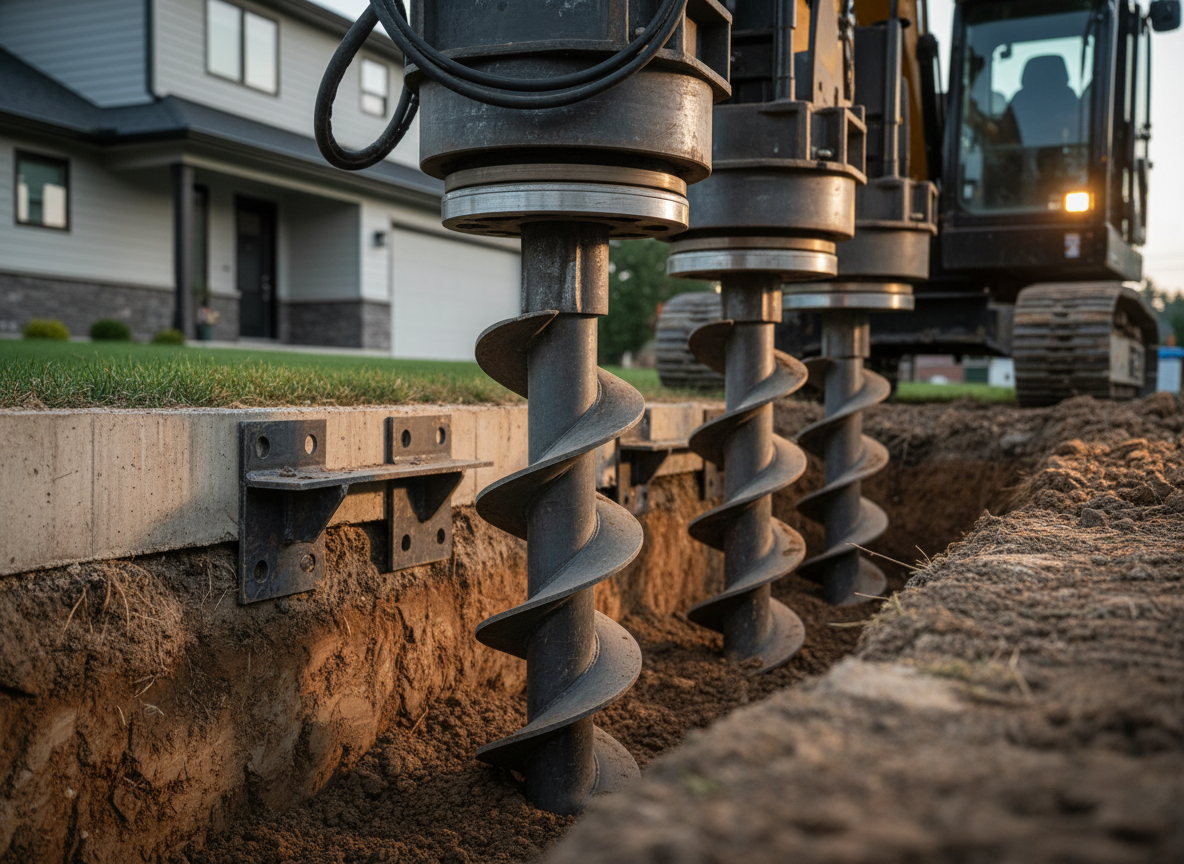
Helical piers (also called screw piles) are large-diameter steel shafts with helical plates that are mechanically screwed into the ground like a giant corkscrew. Their load capacity is calculated from the torque resistance during installation, providing a verified bearing capacity before any load is transferred. Helical piers work in tension and compression, making them suitable for both interior and exterior applications with limited access. For homes throughout Chomedey, Laval-des-Rapides, and Pont-Viau where Champlain Sea clay extends to significant depth, helical piers reaching stable glacial till or rock are the preferred solution.
Push piers (also called resistance piers or hydraulic piers) are driven into the ground using the home's own weight as resistance. As each pier section is hydraulically advanced, it pushes against the soil until reaching refusal on competent material. Push piers are typically faster to install and cost-effective for heavier structures where sufficient dead load is available for installation. Both systems are connected to the existing footing via steel bracket assemblies and then used with synchronized hydraulic jacks to attempt partial or full elevation recovery.
Can Your Foundation Be Lifted Back to Level?
One of the most common questions we receive from homeowners in Auteuil, Fabreville, and Sainte-Dorothée is whether their settled foundation can be raised back to its original elevation. The honest answer: sometimes yes, partially, and it depends heavily on the degree of settlement and how long it has progressed.
Recent settlement — within the last few years — on a home that still has relatively uniform structure is the best candidate for elevation recovery. In these cases, synchronized hydraulic jacking of multiple pier points can raise the foundation incrementally, and interior cosmetic damage (cracked drywall, sticking doors) often self-corrects as the structure re-levels. Elevation recovery of 1–3 inches is regularly achievable.
In cases of long-standing settlement, internal structural changes — rigid floor joists, locked stairways, fixed plumbing — can make significant lifting impractical or risky. In these situations, the goal becomes stabilization: halting all further movement and maintaining the home at its current elevation, preventing the progressive worsening that otherwise continues unchecked.
All pier installations are performed by certified technicians and engineered to local load requirements. We serve all areas of Laval including Chomedey, Vimont, Duvernay, Fabreville, Sainte-Rose, Auteuil, Pont-Viau, Laval-des-Rapides, Sainte-Dorothée, Saint-François, Saint-Vincent-de-Paul, and Laval-Ouest and provide a detailed written report upon project completion.
Service Coverage — Laval
Foundation settlement repair services are available throughout Laval including Chomedey, Vimont, Duvernay, Fabreville, Sainte-Rose, Auteuil, Pont-Viau, Laval-des-Rapides, Sainte-Dorothée, Saint-François, Saint-Vincent-de-Paul, and Laval-Ouest. We offer free structural assessments.
Related Services
View All ServicesFoundation Crack Repair
Permanent crack sealing using advanced epoxy and polyurethane injection — trusted by hundreds of Laval homeowners.
Learn moreStructural Foundation Repair
Strengthen bowing and leaning foundation walls with carbon fiber reinforcement and steel I-beam systems.
Learn moreFoundation Inspection
Comprehensive, no-obligation foundation inspections by certified specialists — identify issues early and protect your home's value.
Learn moreHow We Work
Structural Assessment
A licensed engineer evaluates settlement extent, soil conditions, and load-bearing requirements.
Pier Design
Helical or push piers are specified and engineered to reach stable load-bearing strata.
Installation
Piers are driven or screwed deep into stable soil, then connected to the foundation with steel brackets.
Lift & Stabilize
Hydraulic jacks apply lifting force, and the foundation is stabilized at the target elevation.
Common Questions
Can a settled foundation be lifted back up?
In many cases, yes — partially or fully. Hydraulic lifting can restore some or all of the original elevation. Results depend on the degree of settlement, how long it has progressed, and the structural condition of the home.
How many piers will my home need?
The number depends on the home's size, weight distribution, and extent of settlement. Our engineers provide a precise specification. Typical residential projects require 4–12 piers.
Will my landscaping be disturbed?
Pier installation requires excavation pits around the foundation perimeter, typically 2–3 feet square. Our team carefully restores all disturbed areas upon completion.
How long does pier installation take?
Most residential projects are completed in 1–3 days depending on the number of piers required. The home is fully accessible throughout the project.
Is pier installation covered by home insurance?
Most standard home insurance policies do not cover settlement repair as it is considered gradual damage. We can provide detailed documentation to assist with any insurance inquiries.
Get Your Free Foundation Inspection
No obligation. No pressure. Written assessment provided before any repair recommendations.
Free Foundation Inspections
No-obligation assessments with a written report included
Licensed & Insured
Fully licensed foundation repair contractor in Quebec
Written Warranty Available
Comprehensive written warranties on all repair work