Why This Repair Matters
A French drain is one of the most effective tools for managing groundwater and reducing hydrostatic pressure against your foundation. Whether installed interior around your basement perimeter or exterior around the home's footings, a properly designed French drain system redirects water safely away before it can cause damage.
Key Benefits
- Eliminates hydrostatic pressure buildup
- Prevents basement water infiltration
- Works passively with no mechanical components
- Extends the life of your waterproofing system
- Effective in Laval's high water table areas
How French Drains Work — and Why Laval Homes Need Them
A French drain is a gravel-filled trench containing a perforated pipe that collects groundwater and directs it away from your foundation by gravity. The system works passively — there are no moving parts, no electricity required, and nothing to maintain beyond periodic inspection. Water enters the perforated pipe through hundreds of small holes, travels along the pipe's slope, and exits at a sump pit, storm drain connection, or daylight discharge point.
In Laval, French drains are not just a waterproofing upgrade — for many homes, they are a necessity. The island's clay soils have naturally poor drainage; water doesn't percolate downward quickly and instead moves laterally toward the path of least resistance — your foundation wall. Neighborhoods in Chomedey near the Rivière des Prairies, low-lying sections of Duvernay, and areas in Laval-des-Rapides and Pont-Viau built near former marsh areas have some of the highest groundwater tables in the region. Without a drainage system at the footing level, these homes are in a permanent state of hydrostatic pressure.
Beyond new installations, we also replace failed original perimeter drains — the clay tile or thin plastic drain systems installed in homes built between the 1950s and 1980s. These old systems are commonly found collapsed, root-clogged, or silted shut under homes in Auteuil, Saint-Vincent-de-Paul, and Vimont. A camera inspection of your existing drain can confirm whether replacement is warranted.
Interior French Drain Systems: Minimally Invasive and Highly Effective
Interior French drain installation involves cutting a narrow channel (typically 12–16 inches wide) around the perimeter of the basement floor, excavating to the footing level, installing perforated pipe wrapped in filter fabric within a gravel bed, and then patching the concrete. The collected water is directed to a sump pit where a pump discharges it outside the home.
The primary advantage of interior installation is that it requires no exterior excavation — no disruption to landscaping, fencing, decks, or neighboring properties. It is also unaffected by exterior conditions and can be installed year-round. Interior systems are typically completed in 1–3 days and are significantly more cost-effective than full exterior excavation.
Modern interior drainage systems use dimple-mat drainage channels that capture water seeping through the wall face above the footing — something traditional footing-level pipe alone cannot address. This makes them highly effective at managing the diverse moisture entry patterns typical of older Laval homes in Sainte-Rose, Fabreville, and Sainte-Dorothée.
All interior systems are installed with a sump pump. We recommend battery-backed pumps for homes in high water table areas like Chomedey and low-lying sections of Duvernay.
Exterior French Drain Installation: The Comprehensive Solution
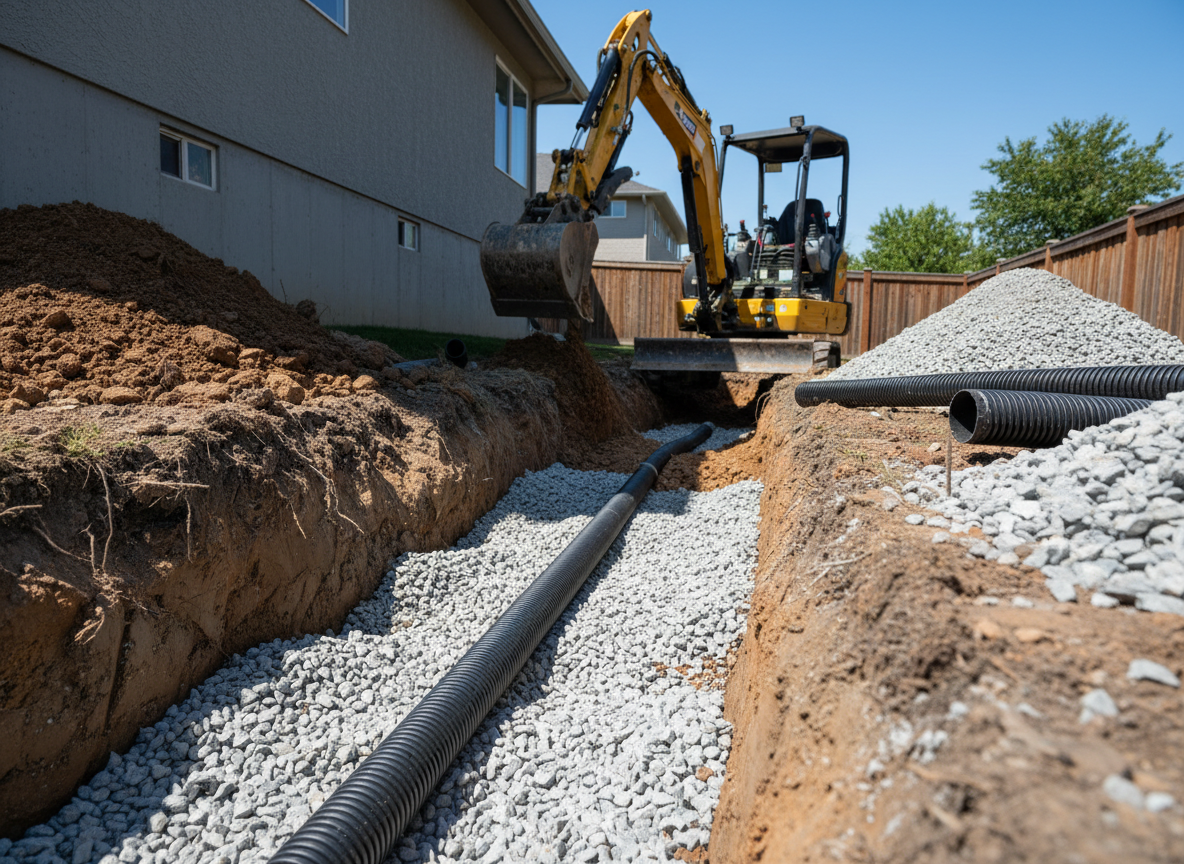
Exterior French drain installation is the most thorough drainage solution for a Laval home. The process involves excavating the foundation perimeter down to the footing, cleaning and re-waterproofing the exposed wall, installing a perforated drainage pipe at the footing base within a granular drainage layer, and then carefully backfilling with clear stone and filter fabric to prevent silting.
Exterior drains intercept groundwater before it ever contacts the foundation wall, reducing hydrostatic pressure to near zero. Combined with a fresh exterior waterproofing membrane, this approach provides the most durable long-term protection. Homes in Saint-François, Laval-Ouest, and Saint-Vincent-de-Paul that have never had drainage systems installed are excellent candidates for full exterior work during landscape renovation or pool installation projects when excavation costs can be partially shared.
Our French drain installation teams serve all areas of Laval including Chomedey, Vimont, Duvernay, Fabreville, Sainte-Rose, Auteuil, Pont-Viau, Laval-des-Rapides, Sainte-Dorothée, Saint-François, Saint-Vincent-de-Paul, and Laval-Ouest. We carry full liability insurance and RBQ certification. Free site assessments are available for all drainage inquiries.
Service Coverage — Laval
French drain installation services available throughout all of Laval including Chomedey, Vimont, Duvernay, Fabreville, Sainte-Rose, Auteuil, Pont-Viau, Laval-des-Rapides, Sainte-Dorothée, Saint-François, Saint-Vincent-de-Paul, and Laval-Ouest. Free drainage assessments available.
Related Services
View All ServicesFoundation Crack Repair
Permanent crack sealing using advanced epoxy and polyurethane injection — trusted by hundreds of Laval homeowners.
Learn moreBasement Waterproofing
Interior and exterior waterproofing systems engineered for Laval's climate — keep your basement dry year-round.
Learn moreConcrete Foundation Repair
Restore deteriorated concrete foundations with resurfacing, structural patching, and full section replacement.
Learn moreHow We Work
Site Evaluation
We assess water flow patterns, soil drainage, and the home's grading to design the optimal drain route.
Excavation
A trench is dug along the target path at the correct slope for gravity drainage.
System Installation
Perforated pipe wrapped in filter fabric is laid in gravel-filled trench and connected to a discharge point.
Backfill & Restore
The trench is backfilled and the surface is restored to its original condition.
Common Questions
Interior or exterior French drain — which is better?
Exterior drains stop water before it reaches the wall and are more comprehensive. Interior drains are less invasive and manage water already in the wall system. Both are effective; the right choice depends on your situation and budget.
Where does the water go?
Water is directed to a sump pit equipped with a pump, a storm drain connection (where permitted), or a daylight discharge point well away from the foundation.
How long does installation take?
A typical interior perimeter drain takes 1–3 days. Exterior systems may take 3–7 days depending on excavation depth and perimeter length.
How do I know if my old drain is still working?
Signs of a failed original drain include recurring basement water, efflorescence (white mineral deposits), or standing water in window wells. A camera inspection of the existing drain can confirm its condition.
Does a French drain need maintenance?
Interior systems require annual sump pump testing. Exterior drains are largely maintenance-free if properly installed with filter fabric. We recommend camera inspection every 10–15 years.
Get Your Free Foundation Inspection
No obligation. No pressure. Written assessment provided before any repair recommendations.
Free Foundation Inspections
No-obligation assessments with a written report included
Licensed & Insured
Fully licensed foundation repair contractor in Quebec
Written Warranty Available
Comprehensive written warranties on all repair work