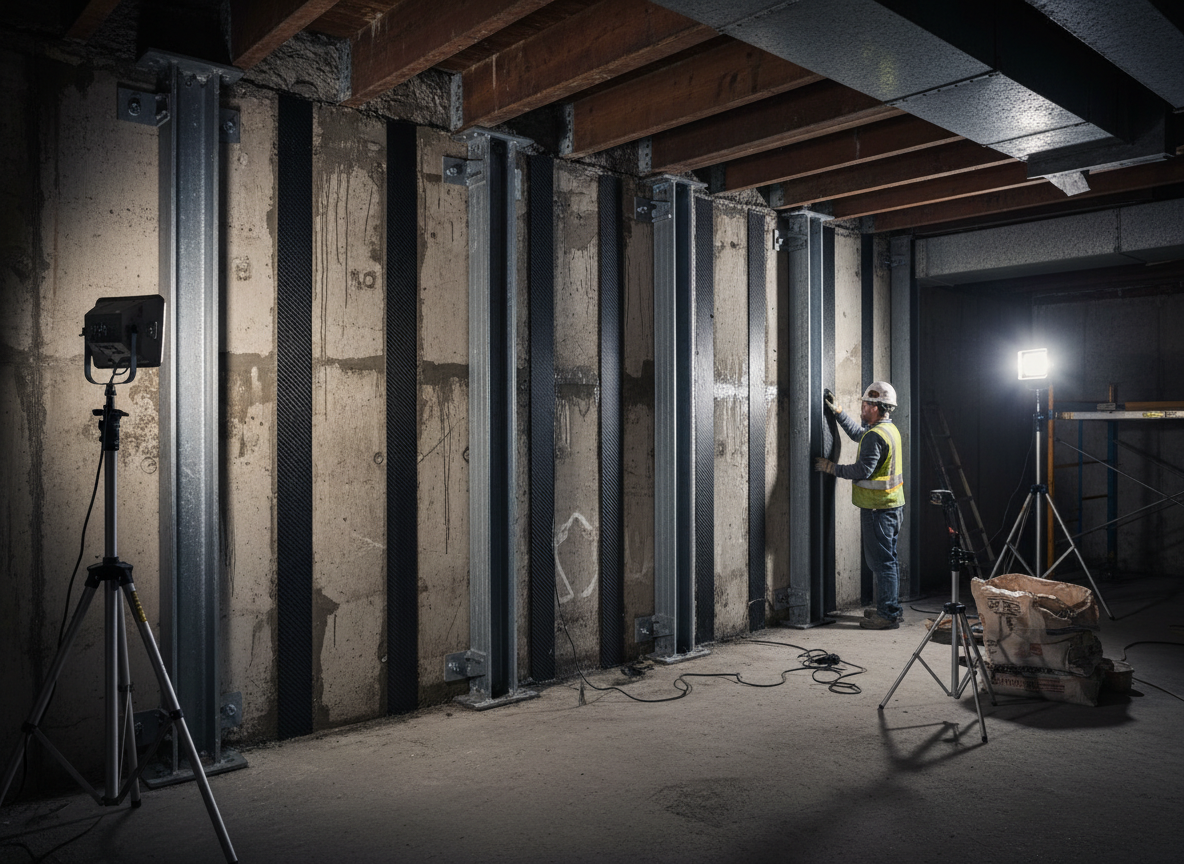
Why This Repair Matters
Bowing or leaning foundation walls are a serious structural warning sign. Lateral soil pressure, hydrostatic forces, and frost heave push against foundation walls over time. If left unaddressed, wall failure is possible. Our structural repair systems stop movement and restore full wall integrity.
Key Benefits
- Stops wall movement immediately
- Restores structural integrity
- Carbon fiber is stronger than steel by weight
- Minimal disruption to interior finishes
- Engineered and certified solutions
When Foundation Walls Bow: Understanding the Mechanism
Foundation wall bowing is a progressive structural failure driven primarily by lateral earth pressure. As saturated clay soils in Laval freeze and thaw, they expand and contract against the foundation wall with forces that can exceed the wall's design capacity — especially in older poured concrete or block foundations built to earlier standards.
Horizontal cracking at the mid-height of a wall — typically 4 to 6 feet below grade — is the clearest sign of lateral pressure-induced bowing. This is the point of maximum bending moment on a wall that is fixed at the top (floor joists) and the bottom (footing), with soil load applied along its full height. As the crack widens, the two sections of wall begin to act independently, and inward displacement accelerates.
In Laval neighborhoods like Chomedey, Auteuil, and Vimont, where older homes have concrete block foundations, block walls are particularly susceptible because the mortar joints — not the blocks themselves — provide limited tensile resistance. A block wall that has shifted even 1 inch inward requires immediate professional evaluation. Unreinforced poured concrete walls in Duvernay and Laval-des-Rapides are somewhat more resistant but can still fail under sustained pressure.
The critical threshold: walls displaced more than 2 inches require more aggressive intervention. Walls displaced less than 2 inches can often be stabilized and gradually straightened using wall anchors over time.
Carbon Fiber Reinforcement: The Modern Standard
Carbon fiber reinforcement has become the preferred solution for bowing foundation walls displaced less than 2 inches. Carbon fiber straps — epoxy-bonded vertically to the interior wall surface — provide tensile resistance that counteracts lateral soil pressure. Carbon fiber's tensile strength exceeds that of steel by weight, it does not corrode, and it adds virtually no thickness to the wall (approximately 1/8 inch), preserving usable space.
The installation process is minimally invasive: no excavation, no interior finishing removal in most cases, and the work is completed in a single day for a typical residential wall. A top plate anchors the carbon fiber strap to the floor system, transferring loads into the structural diaphragm of the house. Once installed, the strap prevents further inward movement permanently.
For walls still in sound concrete condition in Sainte-Rose, Fabreville, and Saint-François, carbon fiber is the ideal intervention — low-profile, permanent, and maintenance-free. It can be covered with drywall or insulation after installation, so future finishing of the space is straightforward.
Wall Anchors and Steel I-Beams: For More Severe Cases
When bowing exceeds 2 inches, or when the wall condition does not support carbon fiber bonding, alternative systems are required. Wall anchors consist of a steel plate bolted to the interior wall face, a steel rod passing through the soil, and a deadman anchor plate buried in the yard. As the soil consolidates seasonally, the anchor rod can be incrementally tightened to gradually pull the wall back toward plumb — the only system that can actually straighten a significantly displaced wall over time.
Steel I-beam bracing (sometimes called steel push piers or wall soldiers) involves installing vertical steel channels against the interior wall face, spanning from the footing to the floor joist. The beam is braced top and bottom, transferring lateral soil load into the structural frame of the house. I-beams are used for severe bowing cases, unstable block walls, or situations where the concrete condition precludes adhesive bonding.
All structural wall repair work we perform in Sainte-Dorothée, Pont-Viau, Laval-Ouest, and across the rest of Laval includes a structural engineer review, written installation documentation, and a warranty. We serve the entire island of Laval — contact us for a free wall assessment.
Related Services
View All ServicesFoundation Crack Repair
Permanent crack sealing using advanced epoxy and polyurethane injection — trusted by hundreds of Laval homeowners.
Learn moreBasement Waterproofing
Interior and exterior waterproofing systems engineered for Laval's climate — keep your basement dry year-round.
Learn moreFoundation Settlement Repair
Stabilize and lift sinking foundations using helical and push pier systems — a permanent engineered solution.
Learn moreHow We Work
Structural Evaluation
We measure the degree of bowing, identify causes, and assess the risk level.
System Selection
Carbon fiber straps, steel I-beams, or wall anchors are selected based on severity.
Wall Preparation
The wall surface is cleaned and any existing waterproofing or insulation is temporarily removed.
Reinforcement Installation
The selected system is installed, bonded to the wall, and anchored to floor joists or footings.
Common Questions
Can a bowing wall be straightened?
Bowing less than 2 inches can often be gradually straightened using wall anchors over time. More severe bowing is stabilized in place with carbon fiber or I-beams to prevent further movement.
Is carbon fiber or steel better?
Carbon fiber is preferred for walls bowing less than 2 inches — it's low-profile, non-corrosive, and very strong. Steel I-beams are used for more severe cases or walls not suitable for adhesive bonding.
How urgent is a bowing wall?
Any inward bowing should be evaluated immediately. Walls can fail suddenly, especially during spring thaw when hydrostatic pressure peaks. Do not delay evaluation.
Will I need to excavate my yard?
Carbon fiber and I-beam systems require no exterior excavation. Wall anchors require burying deadman plates in the yard, though the installation footprint is minimal.
How long does structural repair take?
Carbon fiber strap installation on a typical residential wall is completed in one day. Steel I-beam systems take 1–2 days. Wall anchor installation is similar to I-beams in duration.
Get Your Free Foundation Inspection
No obligation. No pressure. Written assessment provided before any repair recommendations.
Free Foundation Inspections
No-obligation assessments with a written report included
Licensed & Insured
Fully licensed foundation repair contractor in Quebec
Written Warranty Available
Comprehensive written warranties on all repair work